Language never stands still—especially on the internet. One minute, a phrase pops up in a meme or a TikTok caption; the next, everyone’s using it like it’s always been there.
If you’ve scrolled through social media lately, you’ve probably seen people typing “ASL” in their posts or comments. But what does ASL mean in slang, and how did it go viral?
Let’s explore the real meaning of ASL slang, where it came from, how people use it, and why it continues to dominate digital conversations today.
🧠 What Does ASL Mean in Slang?
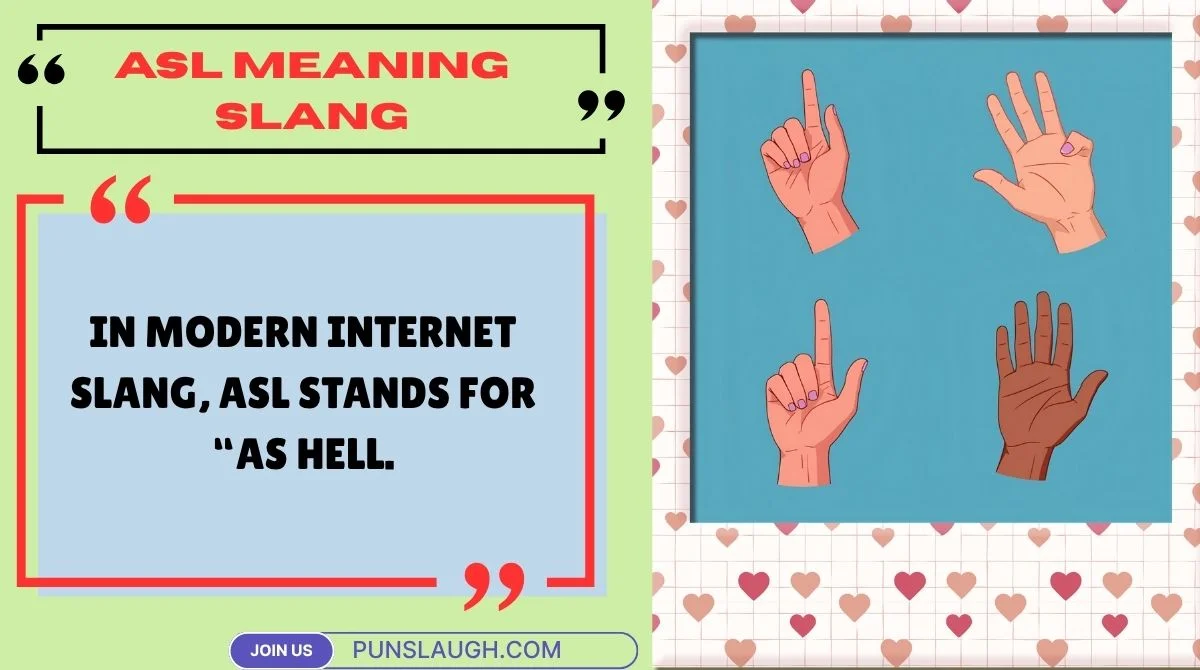
In modern internet slang, ASL stands for “as hell.” It’s used to intensify or emphasize a feeling, quality, or description. Essentially, it means “very” or “extremely.”
For instance:
- “I’m tired asl” → I’m really tired.
- “She’s cute asl” → She’s very cute.
- “That test was hard asl” → That test was extremely hard.
ASL gives ordinary sentences more personality and emotion. It’s short, punchy, and adds flavor to online speech—perfect for the fast-paced nature of texting and social media.
Examples of ASL in Real Context
| Example | Meaning | Emotion/Intent |
|---|---|---|
| “That pizza was good asl” | Very tasty | Positive |
| “It’s cold asl outside” | Extremely cold | Neutral |
| “You annoying asl rn” | Very annoying | Negative |
| “I’m sleepy asl fr” | Super tired, really | Casual emphasis |
In short, ASL is used for exaggeration or emphasis, similar to how you’d raise your tone in real conversation.
🔍 The Origin of ASL Slang
Before becoming a viral term, ASL had a completely different life online.
In the early days of chatrooms (AOL, Yahoo, MSN), people used “ASL” to mean “Age, Sex, Location.” It was a quick way to introduce yourself in online chats:
“Hey, asl?” — meant “How old are you, what’s your gender, and where are you from?”
Over time, as younger users joined new platforms like Snapchat, Twitter, and TikTok, this original meaning faded. Around the late 2010s, people began abbreviating “as hell” into “asl” for convenience and style.
Timeline of ASL’s Evolution
| Year | Meaning | Platform/Trend |
|---|---|---|
| 1990s | Age, Sex, Location | AOL, Yahoo Chat |
| 2000s | Still same (ASL?) | MSN Messenger |
| 2010s | Shift to “as hell” | Twitter, texting culture |
| 2020s | Popular slang intensifier | TikTok, memes, Gen Z language |
This transition shows how language adapts to each new generation of internet users. A term that once asked personal info now expresses feelings with flair.
🤔 ASL vs. ASL (American Sign Language) – Clearing the Confusion
It’s easy to misunderstand “ASL” because it also stands for American Sign Language—a complete visual language used by the Deaf and partially community.
So, when someone types “I’m tired asl,” they’re definitely not referring to sign language! Context is key.
Difference Between ASL as Slang and as a Language
| Context | Meaning | Example |
|---|---|---|
| Slang | “As hell” – an intensifier | “That’s funny asl” |
| Language | American Sign Language | “I’m learning ASL at college.” |
Tip: If ASL appears after an adjective or verb, it’s probably slang. If it’s used as a noun (“learning ASL”), it refers to the language.
💬 ASL in Text, Chats, and Social Media

Social media gave ASL slang a new life. It thrives in places where space is limited and informality rules—like TikTok captions, X/Twitter posts, and DMs.
Here’s how people commonly use it:
- TikTok: “That transition was smooth asl.”
- Snapchat: “You look good asl rn 😭.”
- Twitter/X: “Weather behavior asl today.”
Platforms Where ASL Thrives
- TikTok – Users often comment “funny asl” or “fine asl” under trending videos.
- X/Twitter – Used to add emotion or attitude in short tweets.
- Snapchat – Appears in private conversations for humor or emphasis.
- Instagram – Found in captions or comments, especially in meme pages.
Its lowercase style (asl) reflects casual texting culture—people type fast, skip punctuation, and rely on tone and emojis to fill in emotion.
😂 The Meme Factor: How ASL Went Viral
ASL didn’t just spread—it exploded thanks to memes and TikTok trends. It became part of internet humor, often used sarcastically or ironically.
For example, memes like:
“My sleep schedule messed up asl 😂”
“This food bussin asl fr 🍔🔥”
People began pairing “asl” with other slang like “fr” (for real) or “ong” (on God) to heighten the tone even more.
ASL’s viral nature also came from its flexibility—it can fit almost any situation. You can sound funny, mad, excited, or even dramatic using just three letters.
😄 ASL in Conversations – Positive vs Negative Use
ASL isn’t limited to jokes. It can carry different emotions depending on tone, words, and context.
Positive Uses
- “You smart asl.” → Compliment or admiration
- “This movie funny asl.” → Genuine enjoyment
- “That outfit cute asl.” → Flattering tone
Negative Uses
- “You slow asl.” → Insulting or mocking
- “That game trash asl.” → Negative review or frustration
- “He rude asl.” → Critical tone
Neutral or Casual Uses
- “I’m sleepy asl rn.” → No emotion, just stating fact
- “It’s late asl.” → Simple observation
The key difference is tone. A friendly tone makes ASL sound playful, but a harsh tone can turn it rude. Context is everything.
🔡 ASL vs Other Internet Slang
ASL isn’t alone in the world of online intensifiers. It’s often compared to AF, FR, ONG, and other slang abbreviations.
Comparison Table
| Slang | Meaning | Use Level | Example |
|---|---|---|---|
| ASL | As hell | Mild | “Cold asl” |
| AF | As f*** | Stronger | “Tired af” |
| FR | For real | Affirmation | “That’s true fr” |
| ONG | On God | Emphasis on truth | “That was fun ong” |
| SMH | Shaking my head | Disapproval | “Bro, smh” |
ASL is considered more PG-friendly than “AF,” making it popular among younger users and creators who prefer to keep language clean but expressive.
💭 Should You Use ASL in Conversation or Text?

If you’re texting friends or commenting online, absolutely—ASL fits right in. It helps your tone sound natural and expressive. But, in formal or professional settings, it’s better to skip it.
When It’s Okay to Use
- Casual chats with friends
- Social media posts or comments
- Light-hearted group texts
- Memes or jokes
When to Avoid It
- Work emails or school assignments
- Professional social media posts (LinkedIn, business pages)
- Talking to someone unfamiliar with online slang
Pro Tips
- Keep it lowercase (“asl”) for natural flow.
- Don’t overuse it—too much slang can dilute meaning.
- Pair it with emojis or other slang to adjust tone.
Example:
“That food good asl 😋” → friendly
“That teacher annoying asl 😒” → borderline rude
Knowing your audience matters as much as knowing the slang itself.
📈 Real-Life Examples and Case Studies
Let’s explore how ASL slang spread and evolved in real online communities.
Case Study 1: TikTok Trend
When creators began using “asl” in captions like “This filter funny asl 😂,” the term skyrocketed. The platform’s algorithm favored comments with slang, helping “asl” appear in trending videos.
Case Study 2: Twitter Conversations
On X/Twitter, influencers and meme pages used ASL for comedic timing. Tweets like:
“I’m tired asl but can’t sleep 😭”
went viral because users could instantly relate to the tone.
Case Study 3: Gen Z vs Millennials
Gen Z adopted “asl” as a toned-down alternative to “af,” making it suitable for mixed audiences. Millennials, however, often mistake it for “Age, Sex, Location,” showing how internet language evolves by generation.
🚫 Common Misconceptions About ASL Slang
There’s plenty of confusion around ASL, especially for new users. Let’s clear that up.
Misconception 1: “ASL is rude”
Not necessarily. It depends on how it’s used. Saying “cute asl” is friendly; saying “ignorant asl” is insulting.
Misconception 2: “Only teens use ASL”
While Gen Z made it popular, plenty of adults use it casually online.
Misconception 3: “ASL means American Sign Language here”
Sometimes it does—but slang context makes it clear when it doesn’t.
Misconception 4: “ASL is new”
It’s not new; it’s a recycled abbreviation that found a new meaning in modern culture.
❓ FAQs About ASL Meaning Slang
What does ASL mean on TikTok?
On TikTok, ASL means “as hell.” It’s used to emphasize a point, usually with humor or exaggeration, like “I’m lazy asl.”
Is ASL rude to say?
It depends on tone and context. When used playfully (“funny asl”), it’s fine. When used insultingly (“ignorant asl”), it’s rude.
Is ASL still popular in 2025?
Yes, it’s still common across TikTok, Snapchat, and texting. Slang evolves, but ASL remains one of the most recognized abbreviations.
What’s the difference between ASL and AF?
Both mean “as hell” or “as f***,” but ASL is more socially acceptable and often used by younger users.
Is ASL okay to use in a professional setting?
No. ASL is casual slang. Avoid it in work emails, formal reports, or messages to superiors.
💡 Final Thoughts on ASL Meaning Slang
The evolution of ASL slang perfectly captures how the internet reshapes language. What began as an old-school chat abbreviation (“Age, Sex, Location”) has turned into a universal intensifier meaning “as hell.”
Its journey from chatrooms to TikTok shows how users reinvent language to match modern digital expression. Whether you use it in a joke, a caption, or a casual chat, ASL adds attitude, personality, and authenticity to everyday communication.
Language changes, and that’s part of what keeps it alive—as alive asl, you might say. 😉